1. Executive Context
The Innovation Dead End
If you have ever watched an exciting AI pilot—one that promised to revolutionize a workflow—grind to a halt before reaching production, you have witnessed “Pilot Purgatory.”
It is a common innovation dead end where promising technology is shelved because the associated risks feel unmanageable to compliance and security teams.
This isn’t a failure of technology. It’s a failure of governance. The operating models we use to manage risk were built for a deterministic world of predictable software. Generative and Agentic AI operate on entirely different principles, rendering our old playbooks obsolete.
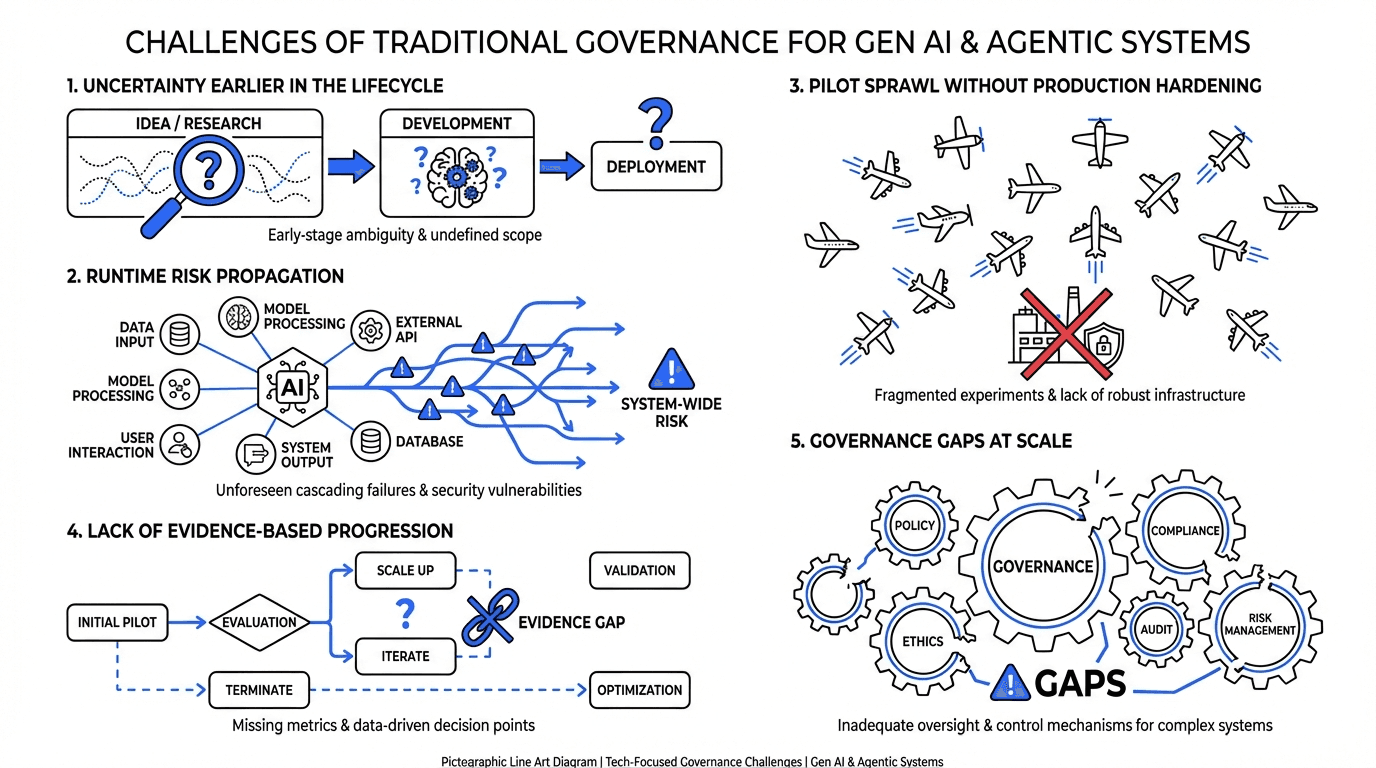
The Core Problem: The Probability Gap
For decades, traditional software governance was built on a simple, predictable contract: f(x)=y. Given the same input, the code would always produce the same output. This allowed risk to be managed almost entirely before deployment.
Generative AI shatters this contract. It operates on a probabilistic reality: P(y|x,context).
- Uncertainty shifts left: Ambiguity exists in the definition phase.
- Risk shifts right: Failures happen in production, not in the build pipeline.
You cannot test for an infinite number of potential user prompts or data contexts beforehand, making old approval methods dangerously insufficient.
The Solution: Enterprise Anchors
The Enterprise Anchors™ framework offers a path forward by reimagining governance not as a pre-deployment gate, but as a dynamic, runtime system. It establishes a “System of Intelligence” that fuses human judgment with machine speed.